
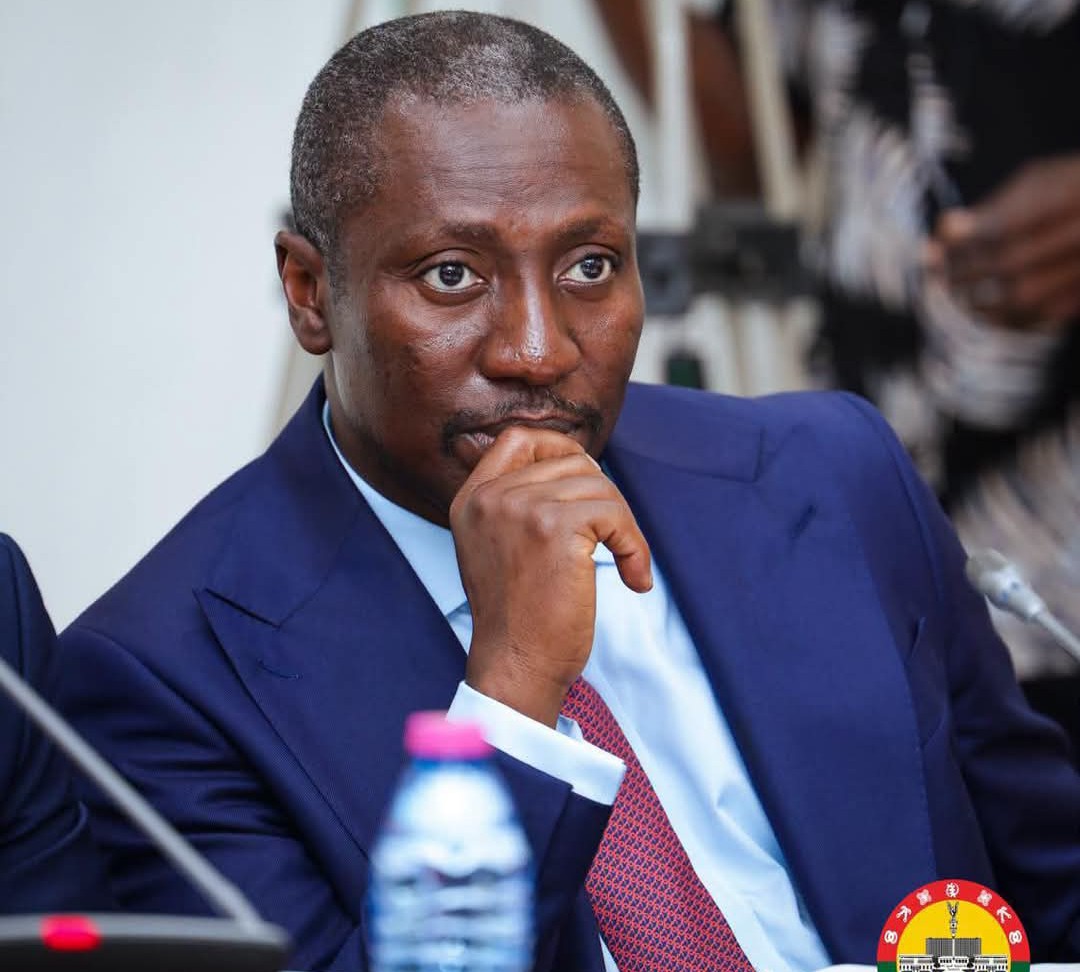
Minority Leader and Member of Parliament for Effutu, Alexander Afenyo-Markin, has called for comprehensive structural reforms at the Electricity Company of Ghana (ECG), arguing that improved revenue collection, financial discipline and operational efficiency are critical to restoring the company’s financial sustainability.
He has cautioned against repeatedly increasing electricity tariffs to address ECG’s financial difficulties, insisting that consumers should not be made to bear the cost of inefficiencies that could be resolved through institutional reforms.
According to him, the power distributor must prioritise closing revenue leakages, improving its metering systems, enforcing payment discipline and strengthening procurement procedures before considering additional financial burdens on electricity consumers.
Mr Afenyo-Markin made the proposals when he attended a luncheon organised in honour of former managing directors and board chairpersons.
In a statement recounting his contributions at the event, the former ECG Board Chairperson said the company’s challenges are largely rooted in systemic inefficiencies that required a national dialogue on structural reforms rather than partisan blame.
Although his tenure was relatively short, he said it provided him with an opportunity to understand the operational pressures facing the company and the difficulties confronting its workforce.
He said his position on the need for structural reforms is consistent with the arguments he presented on behalf of the Minority during the Public Utilities Regulatory Commission’s 2025–2030 Multi-Year Tariff Review in November 2025.
“The central question remains: how do we make ECG financially sustainable, operationally efficient, and reliable without continually passing its inefficiencies on to the Ghanaian consumer?” he asked.
Mr Afenyo-Markin noted that electricity consumers had absorbed tariff increases exceeding 28 per cent over the preceding 19 months, arguing that further increases would not provide a lasting solution to the company’s structural problems.
The Effutu MP identified ECG’s Loss Reduction Programme, introduced in 2023 under the Akufo-Addo-Bawumia administration, as an important intervention that should be sustained and strengthened.
The programme was designed to address operational and revenue challenges, including faulty meters, outdated billing systems and illegal electricity connections.
Citing figures reportedly presented at ECG’s annual general meeting, Mr Afenyo-Markin said the company’s loss after tax declined from GH¢8.25 billion in 2024 to GH¢2.52 billion in 2025, representing a reduction of nearly 70 per cent.
He added that ECG’s revenue increased from GH¢19.6 billion to GH¢22.1 billion over the same period.
New electricity connections also rose by 31.3 per cent to 222,979, while prepaid customers accounted for 53.5 per cent of the company’s customer base.
According to him, the figures demonstrate that operational interventions can improve the company’s financial position without relying solely on tariff increases.
“Reform has achieved what tariff increases alone could not,” he stated.
He, however, cautioned that the gains would not be sustainable unless ECG addressed persistent weaknesses in revenue collection and strengthened its systems for identifying and preventing financial losses.
Mr Afenyo-Markin identified revenue leakages, particularly those associated with metering and billing, as one of the most pressing challenges confronting ECG.
He said the company serves more than three million customers and argued that if just five per cent of its customer base had faulty meters, at least 150,000 accounts could be affected by inaccurate billing.
Such problems, he explained, could result in under-billing, unbilled consumption, delayed bills and inaccurate customer records, depriving the company of revenue that should support its operations.
He therefore called for tighter collection controls, improved reconciliation of payments, integrated payment channels and stronger field inspection teams.
He also advocated protection for whistle-blowers, consistent penalties for offenders and closer collaboration between ECG, local assemblies, traditional authorities and communities to combat illegal connections and electricity theft.
The former Board Chairperson further urged the company to accelerate the use of technology to strengthen revenue protection.
Among his proposals is the establishment of a fully integrated revenue-protection system incorporating a single customer database, smart prepaid meters with remote monitoring capabilities and geographic information system mapping to identify customers and areas vulnerable to illegal connections.
He also recommended digital payment platforms with automated reconciliation, alongside data analytics and artificial intelligence tools to detect unusual consumption patterns.
Additionally, he proposed revenue dashboards and automated exception-reporting systems linked to customer complaints and meter data to help ECG identify discrepancies and respond to potential losses more quickly.
He maintained that a coordinated digital system would improve transparency, strengthen accountability and enable the company to detect revenue losses before they accumulate.
Beyond revenue collection, Mr Afenyo-Markin warned that ECG’s indebtedness had become a broader fiscal concern for the state.
He referred to the 2025 State Ownership Report by the State Interests and Governance Authority, which he said placed ECG among state-owned enterprises with substantial liabilities.
According to him, unpaid obligations can delay grid maintenance, postpone essential infrastructure upgrades and trigger costly capacity-charge claims from independent power producers.
He argued that the company’s financial difficulties should not continue to be addressed through periodic government bailouts without fundamental changes to its financial management.
“Periodic bailouts must give way to institutional discipline,” he stated.
To address the problem, Mr Afenyo-Markin proposed strict enforcement of the revised Cash Waterfall Mechanism to ensure that revenue collections pass through a single audited account and that obligations to entities across the electricity value chain are settled according to established priorities.
He also called for the renegotiation of legacy power purchase agreements based on take-or-pay arrangements, advocating a shift towards take-and-pay terms that better reflect actual electricity demand.
Under the proposed approach, payments for electricity would be more closely linked to the power actually taken, subject to the terms of any revised agreements.
He further urged the Ministry of Finance to introduce automatic monthly deductions to settle outstanding electricity bills owed to ECG by ministries, departments, agencies and other public institutions.
The proposal, he said, would help prevent government institutions from accumulating arrears while the power distributor struggles to meet its own financial obligations.
The Minority Leader also highlighted procurement practices as another area requiring sustained reforms to protect ECG’s finances.
Recounting his experience as Board Chairperson, he said he encountered an arrangement under which vendors could deliver goods to the port and present ECG with bills of lading without adequate verification of the goods actually received.
He argued that the arrangement exposed the company to financial obligations before it had taken custody of the goods.
According to him, the practice also left ECG exposed to port charges, delays and potential losses arising from damaged or missing consignments, as well as disputes over deliveries.
Mr Afenyo-Markin said he led the Board to introduce a change linking contractual completion and payment to verified delivery of goods at ECG’s own facilities.
He stressed that the reform should be maintained to strengthen procurement accountability and ensure that payments are supported by evidence that contracted goods have been received.
Mr Afenyo-Markin said the recovery of Ghana’s power sector requires a decisive shift from policies that place additional financial pressure on consumers to reforms that address operational weaknesses.
He called for the full implementation of the Loss Reduction Programme, including boundary metering, smart prepaid meters and systematic detection of electricity theft.
He also reiterated the need for strict enforcement of the Cash Waterfall Mechanism to ensure that revenue collected within the electricity distribution system is properly accounted for and used to meet essential obligations.
According to him, addressing revenue losses at their source would offer a more sustainable path to financial recovery than repeatedly increasing tariffs for households and businesses.
He maintained that a national conversation on ECG’s structural challenges is necessary to build a financially sustainable and operationally efficient electricity distribution company capable of delivering reliable services without continually transferring the cost of inefficiencies to consumers.
By 1960news.com