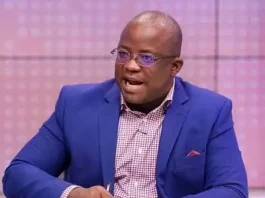

Financial economist and academic Dr Razak Kojo Opoku has criticised the New Patriotic Party’s (NPP) campaign strategy in the 2024 general election, arguing that attempts to distance Dr Mahamudu Bawumia from the perceived failures of the Akufo-Addo administration contributed to the party’s electoral defeat.
According to him, the strategy of portraying former President Nana Addo Dankwa Akufo-Addo negatively to protect Dr Bawumia’s political image proved counterproductive, generating public resentment towards the party rather than strengthening its presidential candidate’s electoral prospects.
Dr Opoku, reminiscing the party’s electoral performance, says the NPP must acknowledge what he described as a strategic mistake in 2024 and adopt a more unified approach ahead of the 2028 general election.
He argued that the party’s attempt to attribute the failures of the Akufo-Addo administration to the former president while presenting Dr Bawumia as the face of its achievements created the impression that the party’s leadership was unwilling to accept collective responsibility for its record in government.
Dr Opoku said the campaign approach contributed to a situation in which many voters became unwilling to recognise even the positive achievements of the Akufo-Addo administration.
He observed that some voters perceived the party’s attempts to separate Dr Bawumia from the administration’s shortcomings as an effort by its leading figures to distance themselves from a government they had collectively served.
According to him, the strategy allowed critics to question why Dr Bawumia, who served as vice president throughout the Akufo-Addo administration, was presenting himself as a candidate capable of performing better than the government in which he had played a prominent role.
“At some point many people were telling Bawumia that he claims that he will do better than Akufo Addo meanwhile he was the main person in that government and so why is he trying to run away from the failures now?” Dr Opoku wrote in a social media post.
He suggested that the question undermined the credibility of the NPP’s campaign message by creating a contradiction between Dr Bawumia’s position in government and his promise to deliver a better administration.
Dr Opoku likened the NPP’s campaign approach to an attempt to make the vice president appear better than the president he served, using the analogy of a mate trying to distinguish himself from the driver in the eyes of passengers.
He argued that the strategy failed to convince voters because Dr Bawumia’s position as vice president made it difficult to separate his political record from that of the government.
“A campaign strategy of making the mate look better than the driver in the eyes of the passengers (voters) clearly was a counter-productive in 2024 general election,” he stated.
In his assessment, the party’s attempt to protect its presidential candidate by placing responsibility for the administration’s failures primarily on Akufo-Addo created an unfavourable perception of the NPP as a political organisation.
Rather than allowing Dr Bawumia to establish a distinct political identity, Dr Opoku suggested, the approach raised questions about the party’s willingness to defend its own record and acknowledge its shortcomings.
His comments point to a broader challenge facing the NPP as it seeks to rebuild public confidence following its defeat in the 2024 presidential and parliamentary elections.
Looking ahead to the 2028 general election, Dr Opoku warned that the NPP could face an even more difficult electoral contest if it continues with what he considers a divisive approach to evaluating its record in government.
He cautioned that the party risks securing less than 38 per cent of the votes if it fails to learn from the mistakes he identified in its 2024 campaign.
“If this strategy continues in 2028, the NPP might not even attain 38% of the votes because the party cannot elevate Kufuor or Bawumia’s positive achievements at the expense of Akufo-Addo’s positive achievements, or vice versa,” he wrote.
His argument is that the party cannot sustainably promote the achievements of former President John Agyekum Kufuor or Dr Bawumia while downplaying the positive record of Akufo-Addo, or adopt the reverse approach.
He maintained that the NPP must recognise the importance of presenting a coherent account of its governance record instead of selectively crediting individuals for successes while assigning responsibility for failures to others.
The warning comes as the party faces the task of repositioning itself for the next general election, with its performance in government and its ability to reconnect with voters likely to remain central to the political debate.
Dr Opoku has urged the NPP to approach the 2028 election with a mindset of collective responsibility, arguing that the party must be prepared to acknowledge both the successes and failures of the Kufuor and Akufo-Addo administrations.
He believes such an approach would help the party avoid the perception that its leaders are attempting to rewrite their collective political history for individual electoral advantage.
At the same time, he called on Dr Bawumia to introduce fresh policy directions that would give the party a forward-looking agenda rather than relying solely on the records of previous administrations.
According to him, the combination of collective accountability and new policy proposals could provide a more credible foundation for the NPP’s preparations for 2028.
The approach, as outlined by Dr Opoku, would require the party to acknowledge its past governance record while clearly explaining how its future policies would address the challenges facing the country.
His position suggests that the NPP’s next electoral strategy should not be limited to defending or distancing itself from particular individuals but should instead focus on presenting a consistent assessment of its time in government and a convincing programme for the future.
Ultimately, Dr Opoku believes that the party’s ability to learn from the 2024 election will be crucial to its prospects in 2028, warning that a failure to embrace collective responsibility could further weaken its standing among voters.
By 1960news.com