
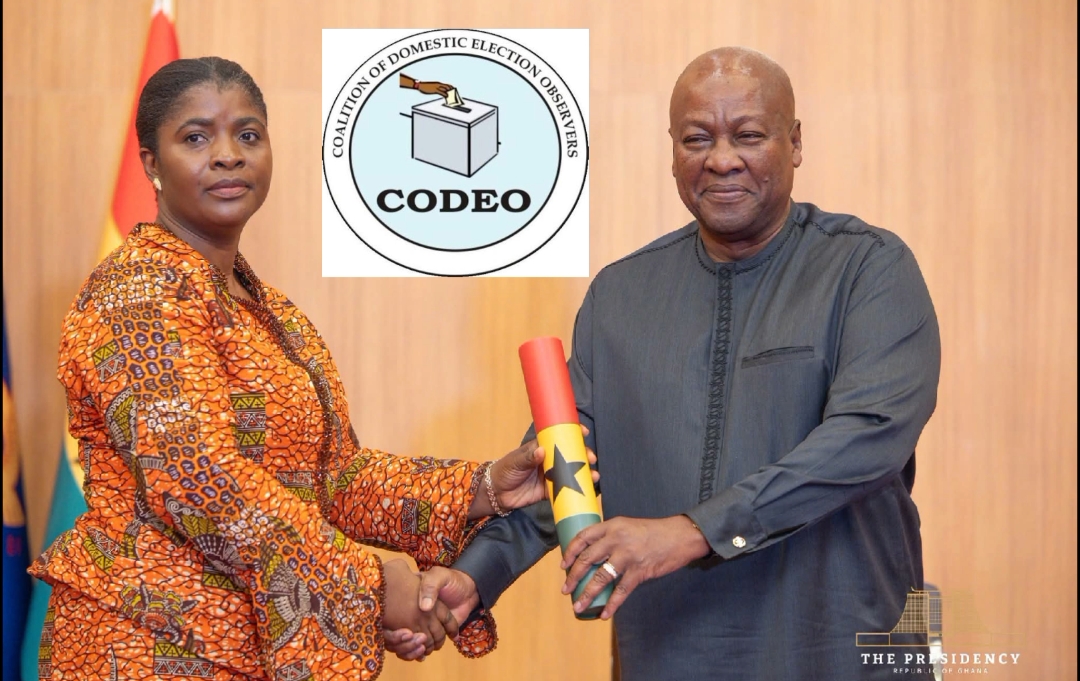
The Coalition of Domestic Election Observers (CODEO) has called on Emelia Affi Agbenyo to resign as Deputy Chairperson of the Electoral Commission (EC), citing concerns that her documented political engagement with the National Democratic Congress (NDC) could undermine public confidence in the Commission’s independence and impartiality.
The coalition has also urged President John Dramani Mahama to demonstrate consistency with his previous calls for reforms in the appointment of Electoral Commission members by encouraging Ms. Agbenyo to step down.
In a press statement issued on Thursday, October 15, 2026, CODEO expressed strong disapproval of Ms. Agbenyo’s appointment and subsequent swearing-in on October 12, arguing that the circumstances surrounding her political activities raise questions about the credibility of the country’s electoral management body.
Although the coalition acknowledged the President’s constitutional authority to appoint members of the Electoral Commission, it maintained that the exercise of that power must take into account the need to preserve public confidence in the institution’s neutrality.
According to CODEO, the credibility of the Electoral Commission depends not only on the actual impartiality of its members but also on the public’s perception of their independence from political parties.
CODEO said its concerns about Ms. Agbenyo’s appointment stem from what it described as publicly documented evidence of her political engagement with the NDC during the 2024 general election campaign.
The coalition cited the NDC’s announcement in August 2024 identifying Ms. Agbenyo as one of the party’s sectoral spokespersons for its election manifesto, with responsibility for the governance portfolio.
It also referred to her professional biography on LinkedIn, where she reportedly identified herself as a spokesperson for the governance sector during the NDC campaign.
The statement further highlighted several social media posts attributed to Ms. Agbenyo during the election period.
According to CODEO, on September 20, 2024, she shared a video featuring the then NDC presidential candidate, John Dramani Mahama, accompanied by the party’s campaign song, Asempa by NACEE, and the hashtags #a_democracy_to_salvage and #voteforchange2024.
The coalition also cited a post dated October 31, 2024, in which Ms. Agbenyo shared a photograph of Mr. Mahama with a message about restoring good governance and putting Ghana back on the path of a thriving democracy.
The post reportedly included the hashtags #voteJM2024 and #voteforchange2024.
CODEO further referenced a December 2, 2024, post on her X account in which she criticised the government over what she described as its treatment of citizens’ concerns and the imposition of a nuisance levy.
For CODEO, these activities raise questions about whether her appointment could affect public confidence in the Electoral Commission’s ability to operate independently of partisan political interests.
The coalition, however, stressed that its concerns are not about Ms. Agbenyo’s professional qualifications or technical competence but about the need to ensure that individuals appointed to the Commission command public confidence in their impartiality.
The coalition said its position on Ms. Agbenyo’s appointment is consistent with its longstanding advocacy for reforms to the process of appointing members of the Electoral Commission.
According to CODEO, it has repeatedly called for a broader and more consultative appointment process that goes beyond the existing constitutional arrangements under Article 70(2) of the 1992 Constitution.
It said it raised similar concerns during the appointments of former Electoral Commission Chairperson Charlotte Osei in 2014 and her successor, Jean Mensa, as well as Deputy Chairpersons Dr. Bossman Asare and Samuel Tettey.
CODEO noted that successive presidents had not adopted its recommendations for a more transparent and consultative process.
The coalition also recalled its involvement in calls for the resignation of Dr. Peter Appiahene in 2023 over concerns about his alleged partisan affiliation with the New Patriotic Party (NPP).
Working alongside the STAR-Ghana Foundation and the Civic Forum Initiative, CODEO had raised concerns about Dr. Appiahene’s appointment, which attracted criticism from several groups, including the NDC.
The coalition said the recurring controversies surrounding the political affiliations of Electoral Commission appointees demonstrate the need for a more credible and transparent appointment framework.
It argued that the issue should be addressed as a matter of principle, irrespective of the political party in government.
CODEO has also questioned the role of the Council of State in the appointment process, calling for greater transparency in how the advisory body discharges its constitutional responsibilities.
Under the existing constitutional arrangement, the President appoints members of the Electoral Commission on the advice of the Council of State.
However, CODEO argued that the absence of a transparent process through which citizens can assess how the Council of State performs this function weakens public accountability and confidence in the appointment system.
The coalition said the latest controversy highlights the need for the Council of State to establish clear procedures that allow citizens to understand how it evaluates and advises on appointments to critical independent institutions.
It maintained that transparency at this stage would help address concerns about political influence before appointments are finalised, rather than allowing disputes to emerge after individuals have assumed office.
CODEO also drew attention to President Mahama’s public position on Electoral Commission appointments while he was in opposition.
The coalition recalled that in March 2023, Mr. Mahama criticised the appointment of individuals he described as known party activists to the Commission and called for an amendment to Article 43(2) of the 1992 Constitution to require parliamentary approval for new commissioners.
According to CODEO, the concerns the President raised at the time are relevant to the controversy surrounding Ms. Agbenyo’s appointment.
It argued that the principles Mr. Mahama advocated while in opposition should be applied consistently under his administration.
The coalition said the credibility of electoral institutions requires political leaders to uphold the same standards regardless of which party controls the government.
It therefore called on the President to demonstrate his commitment to electoral reforms by urging Ms. Agbenyo to resign in the interest of protecting public confidence in the Electoral Commission.
CODEO’s position is that addressing concerns about partisan affiliations should not depend on which political party benefits from an appointment but should be guided by the need to preserve the independence and credibility of the institution.
The coalition warned that repeated controversies over the perceived political affiliations of Electoral Commission members could further weaken public trust in the institution.
It cited Afrobarometer findings indicating that public trust in the Electoral Commission reached its lowest level in 2024.
CODEO attributed the situation, in part, to the failure to adequately address concerns about actual or perceived political bias involving members of the Commission.
It expressed disappointment that successive administrations had not used the presidential appointment process to reduce political tensions surrounding the composition of the electoral management body.
According to the coalition, the independence of the Electoral Commission must be demonstrated through both its institutional arrangements and the public’s confidence in the neutrality of those appointed to lead it.
It said restoring confidence would require political leaders to prioritise the credibility of the electoral process over partisan considerations.
In response to the controversy, CODEO outlined four key demands.
First, it called on Ms. Agbenyo to resign as Deputy Chairperson of the Electoral Commission, arguing that such a decision would help protect public confidence in the institution’s impartiality and credibility.
Second, it urged President Mahama to remain consistent with his previously stated position on partisan appointments by encouraging her resignation.
Third, it called on the government to pursue reforms that would make future appointments to the Electoral Commission transparent, merit-based and capable of commanding confidence across the political divide.
Finally, the coalition urged the Council of State to establish processes through which citizens can obtain information about how it carries out its constitutional responsibilities in relation to appointments.
CODEO said these measures are necessary to address the underlying institutional weaknesses that continue to generate controversy over appointments to the Electoral Commission.
Beyond Ms. Agbenyo’s appointment, CODEO has renewed its demand for a comprehensive review of the process used to select the leadership of the Electoral Commission.
The coalition pointed to recommendations by the Constitutional Review Committee (CRC), which proposed an open, competitive and merit-based appointment process involving a reformed Council of State, the Public Services Commission and prior parliamentary approval.
However, according to CODEO, the government’s position paper rejected the proposed changes to the existing appointment arrangements, although it indicated that the President could adopt transparent and merit-based procedures.
The coalition urged the government to reconsider its position and pursue reforms that introduce independent scrutiny, clear selection criteria and meaningful parliamentary oversight.
It argued that these safeguards would help identify and address concerns about actual or perceived partisan influence before appointments are made.
CODEO maintained that a more transparent process would strengthen the credibility of the Electoral Commission and reduce the likelihood of political disputes undermining public confidence in its leadership.
CODEO said the controversy surrounding Ms. Agbenyo’s appointment underscores the urgency of reforming the constitutional framework governing appointments to the Electoral Commission.
The coalition stressed that constitutional provisions alone may not be sufficient to protect the institution’s independence without a corresponding commitment from political leaders to ensure that appointments are transparent, credible and capable of commanding broad public confidence.
It reiterated that the Electoral Commission must remain an institution whose impartiality is trusted by citizens and political parties alike, regardless of which party holds power.
CODEO is an independent, non-partisan network of civil society organisations, faith-based groups and professional bodies established in 2000 under the auspices of the Ghana Center for Democratic Development (CDD-Ghana).
The coalition, which comprises more than 41 member organisations, works to promote citizen participation in elections and complement the Electoral Commission’s efforts to ensure credible, free, fair and peaceful electoral processes in the country.
By 1960news.com