
Minister of government Communications and Presidential Spokesperson, Felix Kwakye Ofosu, has clashed with former Executive Secretary of the Inter-Ministerial Coordinating Committee on Decentralisation (IMCCoD), Dennis Miracles Aboagye, over the growing description of Ghana as a “Cocaine Coast.”
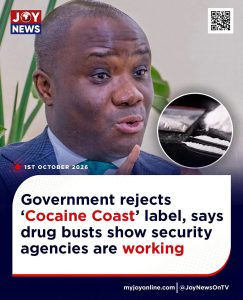
The exchange follows Mr Kwakye Ofosu’s rejection of the “Cocaine Coast” label, arguing that recent drug seizures and arrests demonstrate that the security agencies are actively working to disrupt narcotics trafficking.
Mr Aboagye, however, challenged the government’s position, arguing that the country’s reputation should be addressed through concrete action rather than public statements.
In a response to a post by Mr Aboagye, Mr Kwakye Ofosu described him as a “neophyte” and “time waster,” while urging him to consult people within the New Patriotic Party (NPP) with institutional memory on Ghana’s history with narcotics-related controversies.
“You are both a neophyte and a time waster. Ask those with institutional memory in your party if ‘Cocaine Coast’ or ‘Narcotics People Party’ are descriptions they are hearing for the first time in Ghana’s history,” Mr Kwakye Ofosu wrote.
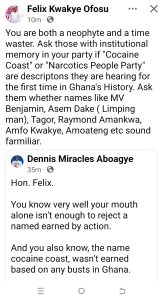
He subsequently cited a number of names associated with past narcotics controversies, including MV Benjamin, Asem Dake, popularly known as the “Limping Man”, Tagor, Raymond Amankwa, Amfo Kwakye and Amoateng.
The minister’s response was directed at comments by Mr Aboagye, who had criticised the government over the recent cocaine cases linked to Ghana.
Mr Aboagye had argued that the “Cocaine Coast” description is not simply a political label that could be dismissed by government officials.
According to him, the description is allegedly based on the scale and frequency of cocaine consignments that had passed through Ghana before being intercepted in other countries.
“You know very well your mouth alone isn’t enough to reject a name earned by action,” Mr Aboagye said in his response to Mr Kwakye Ofosu.
He argued that the recent cases represented a serious security and reputational concern, particularly where consignments allegedly passed through Ghanaian ports before being intercepted abroad.
Mr Aboagye claimed that there had been about seven such incidents within 20 months in which cocaine consignments allegedly entered or passed through Ghana and were only intercepted after leaving the country.
“Our government allowed the cocaine to enter the country and leave the country without any arrest. Not once, not twice but about seven different ones within 20 months,” he alleged.
He added: “We can reject the name by action and not speaking. You get?”
The dispute comes amid renewed scrutiny of Ghana’s role in international narcotics trafficking following a series of major drug seizures linked to consignments originating from or passing through Ghana.
Mr Kwakye Ofosu has previously rejected attempts to link the recent cases to government or NDC officials, saying no evidence had been presented to establish such involvement.
He has also argued that it is important to distinguish between drug consignments that evade law enforcement and cases in which security agencies intercept consignments and arrest suspects.
Speaking on Joy News’ PM Express, he maintained that the existence of drug seizures does not, by itself, establish that Ghana has become a cocaine trafficking hub.
However, he acknowledged that rivalry among some security agencies at the ports had affected efforts to combat narcotics trafficking, saying some institutions had been competing for control rather than sharing information effectively.
The debate has intensified following the seizure of about 3.9 tonnes of suspected cocaine linked to four containers that allegedly left the Tema Port and were intercepted in France.
Ten people have since been put before the courts in connection with the case, including four officers of the Customs Division of the Ghana Revenue Authority.
According to the prosecution’s case, the four containers had been scanned and the images were considered abnormal, but the consignments were nevertheless cleared for export. The accused persons have denied the charges.
The case has triggered questions about the effectiveness of Ghana’s port security and the coordination among agencies responsible for preventing narcotics trafficking.
Earlier in August, 866 parcels of cocaine valued at about US$6.9 million were also discovered at the Tema Harbour, reportedly concealed in sacks of gari and destined for London.
Other narcotics cases have subsequently been reported in different parts of the country, further fuelling the debate over Ghana’s emerging international image in relation to drug trafficking.
The phrase “Cocaine Coast” is not new to Ghana’s political discourse.
Former NDC Deputy General Secretary Koku Anyidoho recently disclosed that he coined the expression as a political campaign description during the controversy surrounding the MV Benjamin case under the administration of former President John Agyekum Kufuor.
The renewed use of the phrase has therefore become part of a broader political argument between the governing NDC and the opposition NPP over Ghana’s handling of narcotics trafficking.
While opposition figures have pointed to the quantity and number of recent seizures linked to Ghana as evidence of serious weaknesses in the country’s drug-control systems, government officials have emphasised arrests, seizures and institutional interventions as evidence that security agencies are responding to the threat.
The disagreement between Mr Kwakye Ofosu and Mr Aboagye consequently goes beyond the terminology itself, touching on questions about Ghana’s international reputation, port security, institutional coordination and the effectiveness of the country’s narcotics-control regime.
By 1960news.com

