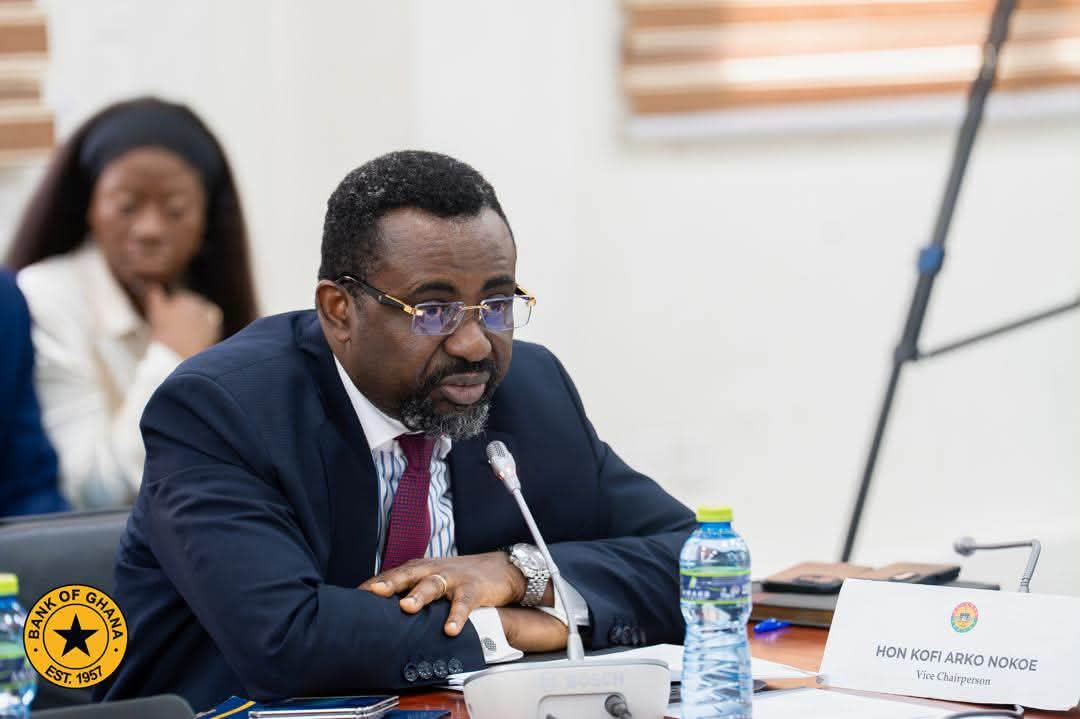
The Governor of the Bank of Ghana (BoG), Dr Johnson Pandit Asiama, has reported significant improvements in Ghana’s macroeconomic performance during the first half of 2026, citing economic growth of 6.4 per cent, declining lending rates, increased private sector credit and stronger external reserves.
Dr Asiama made the disclosure on Friday, November 6, 2026, when he appeared before Parliament’s Committee on Economy and Development to brief members on monetary policy and developments in the domestic and global economy during the first half of the year.
His presentation highlighted progress in the country’s economic recovery, particularly in the areas of inflation management, interest rates, external sector performance and the resilience of the banking industry.
Providing an overview of monetary policy decisions, the Governor said the Bank of Ghana reduced the Policy Rate from 18.0 per cent to 14.0 per cent through cuts implemented in January and March 2026.
The Monetary Policy Committee subsequently maintained the rate at 14.0 per cent during its May, July and September meetings.
According to Dr Asiama, the decision to maintain the rate was informed by the need to consolidate the gains made in stabilising the economy while remaining cautious about emerging inflationary pressures.
He explained that developments in the international oil market, coupled with domestic price pressures, required a measured approach to monetary policy to prevent a reversal of the progress achieved in bringing inflation under control.
The Bank’s position reflects an effort to balance the need to support economic activity with its primary responsibility of maintaining price stability.
On economic growth, Dr Asiama disclosed that Ghana’s real Gross Domestic Product (GDP) expanded by 6.4 per cent in the first quarter of 2026, indicating sustained growth in economic activity.
The development comes amid efforts by the government and the central bank to strengthen macroeconomic stability and improve the business environment.
The Governor also reported that inflation declined significantly to 3.2 per cent in March 2026 before rising to 5.3 per cent in June.
Despite the increase recorded in June, he noted that inflation remained below the Bank of Ghana’s medium-term target band of 6 to 10 per cent.
The inflation figures suggest that price pressures remained relatively contained during the period under review, although the subsequent increase highlighted the importance of maintaining vigilance against emerging risks.
The Governor further highlighted improvements in lending conditions, disclosing that the average lending rate declined from 27.0 per cent to 15.6 per cent during the period.
The reduction represents a substantial easing in borrowing costs and could improve access to financing for businesses and individuals.
Dr Asiama also reported that private sector credit grew by 41.2 per cent, reflecting increased credit expansion to businesses and other private sector participants.
The growth in credit is significant for economic activity, as access to affordable financing remains an important factor in supporting business expansion, investment, job creation and productivity.
However, sustaining the improvement will depend partly on continued macroeconomic stability and the ability of financial institutions to maintain responsible lending practices.
On the external sector, Dr Asiama reported that Ghana recorded a trade surplus of US$8.81 billion during the period under review.
The country also posted a current account surplus of US$5.1 billion, reflecting a favourable balance between external receipts and payments.
The Governor disclosed that Ghana’s gross international reserves stood at US$12.94 billion, equivalent to approximately five months of import cover.
The reserve position provides an important buffer against external economic shocks and supports the country’s capacity to meet international payment obligations.
The figures also point to an improvement in Ghana’s external position, although maintaining adequate reserves will remain essential to supporting exchange rate stability and strengthening investor confidence.
Dr Asiama also reported improved indicators within the banking industry, with total banking sector assets increasing by 30.7 per cent to GH¢502.4 billion.
He said the industry’s Capital Adequacy Ratio stood at 20.4 per cent, indicating that banks maintained capital buffers above the minimum regulatory requirement.
Another notable development was the reduction in the Non-Performing Loans (NPL) ratio from 23.1 per cent to 16.1 per cent.
The decline represents an improvement in asset quality and suggests progress in addressing the accumulation of bad loans within the banking sector.
The Governor’s presentation underscored the importance of maintaining a well-capitalised and resilient banking industry capable of supporting economic growth while managing credit risks.
Beyond the macroeconomic indicators, the Governor outlined a number of policy and institutional reforms being pursued by the Bank of Ghana to strengthen monetary management and improve transparency.
One of the measures is the introduction of a uniform Cash Reserve Ratio (CRR) of 20 per cent.
The reform is intended to establish a consistent reserve requirement framework for financial institutions, supporting more effective liquidity management within the banking system.
Dr Asiama also highlighted the introduction of a transparent and rules-based foreign exchange intervention framework.
The framework is expected to provide greater clarity and predictability in the Bank’s foreign exchange operations while strengthening confidence in the management of the country’s currency market.
Another major initiative is the Ghana Accelerated National Reserve Accumulation Programme (GANRAP), which seeks to increase the country’s international reserves to the equivalent of 15 months of import cover by 2028.
The programme forms part of broader efforts to build a stronger external buffer, improve resilience against global economic shocks and enhance Ghana’s capacity to manage external vulnerabilities.
Achieving the target would require sustained efforts to strengthen foreign exchange inflows, manage external obligations and maintain prudent reserve management practices.
Dr Asiama reaffirmed the Bank of Ghana’s commitment to maintaining price stability, promoting transparency and ensuring accountability in the discharge of its responsibilities.
He also emphasised the importance of keeping Parliament and the Ghanaian public informed about developments in monetary policy and the broader economy.
His appearance before the Committee provided Parliament with an opportunity to assess the Bank’s policy direction, examine economic performance and consider the measures being implemented to safeguard macroeconomic stability.
The briefing comes at a time when Ghana continues to pursue economic recovery, with policymakers facing the dual responsibility of consolidating recent stability gains while creating conditions for sustainable growth, increased investment and improved living standards.
The Bank of Ghana’s ability to sustain the gains will depend on how effectively it manages inflationary risks, supports financial sector stability and responds to developments in the global economy.
By 1960news.com