
The Ghana Irrigation Development Authority (GIDA), in partnership with private real estate developer (Jolly Homes), has announced plans to redevelop the Amrahia Dam into a multi-purpose facility that will boost agriculture, promote aquaculture, and provide recreational opportunities while protecting one of the area’s most important water resources.
The initiative comes amid growing concerns over increasing encroachment around the dam, which receives water from the Aburi Mountains and serves as a vital source of irrigation for vegetable farmers and surrounding communities.
Speaking after touring the site, GIDA’s Deputy Director in charge of Stream Oversight, Joseph Nartey, said the Authority was invited by the Ministry to collaborate with the private developer on the project.
According to him, GIDA had already conducted preliminary technical studies on the dam last year, including topographical surveys and initial engineering designs, with another comprehensive assessment now planned before construction begins.
 Joseph Nartey, Deputy Director in charge of Stream Oversight, GIDA
“We were approached by the Ministry because a private investor wanted us to collaborate to develop this dam into a multi-purpose facility. We came this morning to inspect the site and assess its current condition. Our engineers had already undertaken an assessment last year, including topographical surveys and preliminary designs. We will conduct another comprehensive assessment before implementation begins,” he explained.
Mr. Nartey said the redevelopment would preserve the dam while expanding its usefulness beyond irrigation.
He explained that the upgraded facility would primarily support agricultural activities downstream while creating opportunities for recreation, fishing and other environmentally sustainable uses.
“The essence of this dam is to support agriculture downstream. At the same time, residents of the estate and surrounding communities can also use it for recreational purposes, while others can engage in fishing activities,” he said.
During the inspection, officials also observed fish cages installed in portions of the dam, which they said would be considered as part of the Authority’s holistic redevelopment strategy.
Mr. Nartey warned that illegal activities around the catchment area, including farming, sand winning and gravel extraction, are causing excessive siltation that threatens the lifespan of the dam.
He noted that runoff from disturbed lands upstream washes large quantities of sediment into the reservoir whenever it rains.
“The colour of the water clearly indicates that significant amounts of silt are entering the dam. This is largely due to farming, sand winning and gravel extraction upstream. If this continues unchecked, the dam will deteriorate much faster than expected,” he cautioned.
To address the problem, GIDA plans to undertake extensive desilting works that will restore the reservoir’s storage capacity.
He said the dam is expected to reach an average depth of about three metres after desilting, subject to final engineering designs.
 GIDA inspection team during the tour at Amrahia Dam
With the increased depth of the rehabilitated dam, GIDA is also planning public education campaigns to discourage unsafe activities such as swimming.
Mr. Nartey stressed that while the dam would become a valuable community asset, it would also pose significant dangers to people who enter the water without proper precautions.
“If you don’t know how to swim, you shouldn’t enter the water. Once the dam is desilted, it will become much deeper, and people could easily drown. We will educate residents to appreciate the risks and ensure the facility is adequately protected,” he said.
One of the key components of the redevelopment project will be the enforcement of legally required buffer zones around the dam.
Mr. Nartey disclosed that some structures may have to be demolished if they are found to be within protected areas.
He explained that once the dam is fully rehabilitated, increased water levels could result in backflow that may flood buildings located too close to the reservoir.
“There is supposed to be a buffer zone around every dam. Where people have built within that zone, they will have to move. If demolition becomes necessary, it will be carried out because public safety must come first,” he stated.
He added that GIDA would submit recommendations to the government identifying the appropriate buffer zone and advising that no future developments should be permitted within those protected areas.
Individuals currently developing properties within the designated zone, he warned, would be required to halt construction and vacate if necessary.
Responding to public reports suggesting that the Jolly Homes estate had been constructed within the dam itself, Mr. Nartey dismissed the claims as inaccurate.
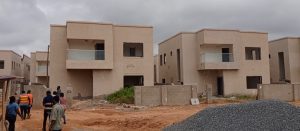
According to him, GIDA’s assessment confirmed that the estate is not situated inside the dam or within its core catchment area.
He explained that while part of the estate lies within the broader catchment, developers had complied with earlier technical advice by avoiding construction in sensitive sections.
He noted that low-lying portions of the site identified during earlier assessments would instead be used for non-residential facilities such as a swimming pool rather than housing infrastructure.
“Based on the site plan we reviewed, the estate is not sitting in the dam or within the protected catchment area. During our earlier assessment, we identified sections where development should not take place. The developers have indicated that the low-lying area will be reserved for recreational facilities, including a swimming pool, rather than residential buildings,” he clarified.
The proposed redevelopment is expected to safeguard the Amrahia Dam against further degradation while improving irrigation, supporting food production, enhancing environmental conservation and creating a recreational destination for residents.
GIDA says it will continue engaging government, developers and surrounding communities as plans for the multi-purpose project progress.
By 1960news.com

