
The Bank of Ghana has directed Mobile Money Fintech Limited (MMFL) to suspend the implementation of its proposed 0.75 percent fee on direct mobile money wallet-to-bank transfers following widespread public concern and stakeholder reactions.
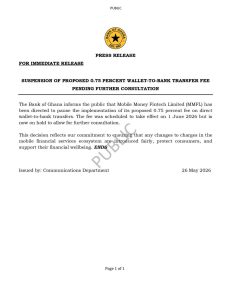
The fee, which was scheduled to take effect on June 1, 2026, has now been put on hold pending further consultations, according to a press release issued by the central bank on Monday, May 26, 2026.
In the statement signed by the Communications Department of the Bank of Ghana, the regulator explained that the decision was taken to allow for broader engagement on the proposed charge and to ensure that any adjustments within the mobile financial services ecosystem are fair and consumer-friendly.
“The Bank of Ghana informs the public that Mobile Money Fintech Limited (MMFL) has been directed to pause the implementation of its proposed 0.75 percent fee on direct wallet-to-bank transfers,” the statement said.
It added that the suspension demonstrates the central bank’s commitment to protecting consumers while promoting financial inclusion and digital financial services across the country.
“This decision reflects our commitment to ensuring that any changes to charges in the mobile financial services ecosystem are introduced fairly, protect consumers, and support their financial wellbeing,” the release emphasized.
The proposed fee had sparked intense public debate in recent days, with many mobile money users, digital finance advocates, and industry observers expressing concern that the charge could discourage the use of digital payment platforms and place additional financial burdens on ordinary Ghanaians.
Critics argued that introducing an additional charge on wallet-to-bank transfers at a time when the country is pushing for a cash-lite economy could undermine efforts aimed at deepening financial inclusion and increasing digital transaction adoption.
The suspension is expected to bring temporary relief to millions of mobile money users and businesses who rely heavily on wallet-to-bank transactions for daily commercial activities.
Mobile money remains one of the most widely used financial services in Ghana, playing a critical role in payments, savings, remittances, and access to banking services, particularly among the unbanked and underbanked population.
The Bank of Ghana has not indicated when consultations on the proposed fee will conclude or whether the charge could be reviewed or reintroduced in a different form after stakeholder engagement.
By 1960news.com

