
The Ghana National Cocoa Farmers Association (GNACOFA) has petitioned President John Dramani Mahama to overhaul how farmer welfare is managed.
The association is calling for the immediate establishment of a national committee to ensure that farmers’ social security is no longer “tied to the apron strings” of COCOBOD.
This appeal follows a clarifying press release issued on February 19, 2026, which highlighted a growing exodus from the industry.
GNACOFA argues that cocoa farming is losing its appeal as a preferred occupation, primarily due to what they describe as “constitutional neglect.”
The friction between smallholder farmers and the government has reached a boiling point, fueled by a lack of financial security for those who spend their lives tilling the soil.
According to GNACOFA, the law is already on their side, but it is not being followed correctly.
Under the COCOBOD Act (PNDC Law 81), a Welfare Fund is supposed to be funded by 10% of COCOBOD’s profits.
However, the association has pointed out a critical failure, noting that the fund has never been structured to align with the National Pension Act (Act 766).
They have explained that career farmers and their families are left without a formal safety net or retirement structure, putting them at a significant occupational disadvantage compared to other sectors.
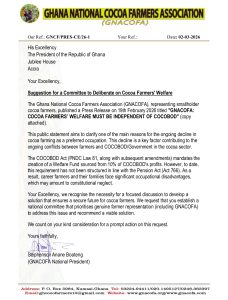
”Cocoa farmers’ welfare must be independent of COCOBOD,” the association stated, emphasizing that the current system is a key driver of the industry’s decline.
Consequently, GNACOFA has requested the President to establish a National Committee specifically tasked with:
Deliberating on a sustainable welfare model;
Integrating farmer pensions into the national framework (Act 766); and
Ensuring genuine representation, with GNACOFA and other authentic smallholder voices leading the conversation.
GNACOFA believes that only by decoupling welfare from the administrative bureaucracy of COCOBOD can the industry attract the next generation of farmers and end the cycle of conflict.
With cocoa serving as the backbone of the Ghanaian economy, the “occupational disadvantage” mentioned by GNACOFA poses a risk to national stability and food security.
If the youth see no future in the fields due to a lack of retirement security, the industry faces an existential threat.
By 1960news.com

