The Ghana National Cocoa Farmers Association (GNACOFA) has issued a bold ultimatum to the Ghana Cocoa Board (COCOBOD), demanding an end to what they describe as “long-standing neglect and suppression.”
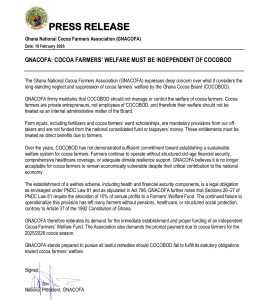
In a press statement, the Association argued that cocoa farmers as private entrepreneurs should no longer have their welfare managed as an internal administrative matter by COCOBOD.
GNACOFA’s primary contention is that cocoa farmers are independent business owners, yet they are treated as subordinates.
The Association has clarified that essential farm inputs, such as fertilizers and ward scholarships, are not “gifts” from the government or taxpayers. Instead, they are mandatory provisions from off-takers and should be treated as direct entitlements due to the farmers.
The Association highlighted a significant gap between the contribution cocoa farmers make to the national economy and the social protection they receive.
According to GNACOFA, COCOBOD has failed to deliver on establishing an Old-Age financial security as most farmers lack a structured pension system.
Moreover, there is no dedicated health coverage for those working in the sector whereas adequate support to combat changing environmental conditions remains absent.
GNACOFA pointed to specific legal frameworks that they claim are being ignored: PNDC Law 81 (Sections 26-27)
This requires an allocation of 10% of annual profits to a Farmers’ Welfare Fund.
Act 766: Further stipulates the legal obligation for welfare and financial security.
GNACOFA argues the current neglect contradicts the constitutional mandate for social protection.
The Association has laid out two non-negotiable demands including the immediate establishment and funding of a Cocoa Farmers’ Welfare Fund that operates independently of COCOBOD’s direct control and immediate settlement of all monies due to cocoa farmers for the current season.
The association says it stands prepared to pursue all lawful remedies should COCOBOD fail to fulfill its statutory obligations toward cocoa farmers’ welfare.”
This standoff signals a potential shift in the power dynamics of Ghana’s cocoa sector.
Below is the full statement