
Ghana has long maintained its status as a leading coconut producer in Africa, with the Nzema area serving as the primary engine behind this national success.
For generations, coconut cultivation has been more than just farming; it is the economic backbone of local communities, fueling livelihoods through oil processing, trading, and large-scale agriculture.
However, this vital industry is currently under siege by a devastating pathogen known as Cape Saint Paul’s Wilt Disease (CSPWD).
While often spoken of alongside other blights, Cape Saint Paul’s Wilt Disease remains a fatal condition for the coconut industry.
The disease is relentless, attacking the heart of the palm and leading to rapid yellowing which is one of the earliest visible signs of infection, starting from the lower fronds.
In most cases, the disease results in the “telephone pole” effect, where the entire crown falls off, leaving only a dead trunk.
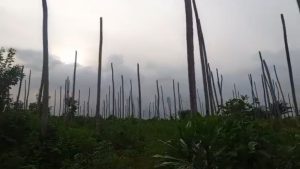 Affected coconut plantation in Jomoro constituency
Recent reports indicate that the outbreak has reached critical levels, particularly in the Jomoro and Nzema East districts, where vast plantations have been decimated.
In response to the growing crisis, the Municipal Chief Executive (MCE) of Jomoro, Hon. Benedict Boadi, has outlined strategic measures to combat the spread and restore the sector.
According to the MCE, the assembly is prioritizing a rejuvenation program centered on replanting and technical intervention.
”The coconut industry supports livelihoods for farmers, laborers, and processors alike,” Hon. Boadi stated.
“The assembly is doing everything within its power to halt the spread of this disease.”
 Hon. Benedict Boadi, MCE, Jomoro
While local efforts are underway, Hon. Boadi has issued an urgent appeal to the Ministry of Food and Agriculture (MoFA) and specialized Crops Research Centers.
He emphasized that high-level scientific intervention is necessary to fully salvage the situation and protect the region’s economic future.
The assembly is currently promoting the planting of resistant hybrid varieties to replace lost groves, as these have shown a higher tolerance to the local pathogens compared to the traditional West African Tall variety.
Farmers in the region are urged to cooperate with Agriculture Extension Officers to identify early symptoms and prevent further cross-contamination between farms.
By 1960news.com

