
The Edina Traditional Council in the Komenda Edina Eguafo Abrem (KEEA) Municipality of the Central Region has threatened to prevent visitors from accessing the Elmina Castle if the Ministry of Tourism fails to settle outstanding royalties allegedly owed the traditional authority.
The Council says it has repeatedly raised concerns over the non-payment of a 20 percent share of proceeds from the management of the historic facility, but its demands have not received the desired response.
According to the Traditional Council, the Elmina Castle is situated on lands belonging to the Edina Traditional Area, and it is therefore entitled to royalties from activities at the facility.
The Council claims that although the Ghana Museums and Monuments Board (GMMB), under the Ministry of Tourism, is responsible for managing the country’s castles and other heritage sites, the 20 percent royalties due the Edina Traditional Council have not been paid since 2009.
The Paramount Chief of the Edina Traditional Council, His Royal Majesty Nana Kodwo Conduah VI, made the disclosure during the 544th anniversary commemoration of Elmina Castle and the relaunch of the Ghana Museums and Monuments Board Heritage Dialogue Series at the castle.
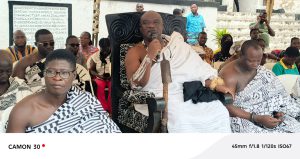
His Royal Majesty Nana Kodwo Conduah VI, Paramount Chief, Edina Traditional Council
Nana Conduah VI appealed directly to the Minister of Tourism, Culture and Creative Arts, Abla Dzifa Gomashie, to intervene and resolve the matter before the Council is forced to take what it described as traditional measures.
He warned that failure to address the outstanding concerns could lead the traditional authority to perform rituals and invoke the gods of the Elmina land against operations at the castle.
“I am calling on the Minister of Tourism, Hon. Abla Dzifa Gomashie, to address our concerns, or we will be compelled to carry out our threat by performing traditional rituals and invoking the gods of Elmina land against the operations of Elmina Castle in the coming days,” Nana Conduah VI declared.
The Paramount Chief said the Council’s position was not intended to undermine tourism but was borne out of concerns over what it considers a prolonged failure to honour the traditional authority’s entitlement.
Nana Conduah VI recalled that during the administration of former President John Agyekum Kufuor, the then Minister of Tourism, the late Jake Obetsebi-Lamptey, released some funds to the Traditional Council following several appeals.
He said the money received at the time was put to use in supporting development within the traditional area.
According to him, part of the funds was used to assist needy but brilliant students to pursue their education, while other portions supported important community projects.
He, however, alleged that after the administration of former President Kufuor, the payment arrangement was discontinued and the Council has since not received the 20 percent royalties it says it is entitled to.
The Council is therefore demanding that the government and the relevant authorities address the matter to prevent the dispute from escalating.
The concerns were raised as stakeholders gathered to commemorate the 544th anniversary of Elmina Castle and relaunch the Ghana Museums and Monuments Board’s Heritage Dialogue Series.
The programme was held under the theme, “Reclaiming Ghana Museums and Monuments Board’s Legacy; Advancing Museums, Heritage and Scholarship.”
The event brought together students of Edinaman Senior High School, officials of the KEEA Municipal Assembly, representatives of the Ghana Tourism Authority, the Ghana Heritage Conservation Trust, the Centre for National Culture, traditional leaders, heritage professionals and residents.
Speaking at the event, the Central Regional Director of the Ghana Museums and Monuments Board, Clifford Mensah, called on Ghanaians to use the anniversary and the heritage dialogue as an opportunity to reflect on the country’s history and the responsibility of preserving its heritage.
He urged the public to transform remembrance into concrete responsibility by taking steps to protect historical sites for future generations.
Mr Mensah said castles such as Elmina Castle must continue to serve not only as places where the painful history of the past is confronted but also as centres of remembrance, learning and renewal.

Clifford Mensah, Central Regional Director, Ghana Museums and Monuments Board
He encouraged stakeholders and the public to participate actively in efforts aimed at preserving Ghana’s heritage.
Historian Professor Anthony Annan-Prah, who delivered the keynote address, also examined the broader historical and cultural significance of Elmina Castle and the introduction of European castles and forts along Ghana’s coast.
He said the establishment of castles by foreigners had significant consequences for the culture and customs of communities where they were built.
According to Prof. Annan-Prah, the presence of foreign powers and their trading activities contributed to changes in the beliefs, names of towns and traditional trade practices of local communities.
He said the historical legacy of the castles should therefore be understood beyond their physical structures, as they also represent a period that profoundly influenced Ghanaian society.
Prof. Annan-Prah urged Ghanaians to acknowledge and forgive the atrocities associated with the transatlantic slave trade while ensuring that the lessons of history are not lost.
He called on citizens to continue promoting Ghanaian heritage and preserving historical sites as important resources for educating present and future generations.
The anniversary celebration and Heritage Dialogue Series highlighted the need for stronger collaboration among traditional authorities, government institutions, heritage managers, historians and communities in preserving Ghana’s historical assets.
For the Edina Traditional Council, however, the question of outstanding royalties remains unresolved.
The Council’s threat to restrict access to Elmina Castle and resort to traditional rituals has added urgency to its demand for engagement with the Ministry of Tourism and the Ghana Museums and Monuments Board.
Stakeholders are consequently expected to find a mutually acceptable solution that addresses the Council’s concerns while protecting Elmina Castle’s status as one of Ghana’s most significant historical and tourism sites.
By Kwame Kakraba

