
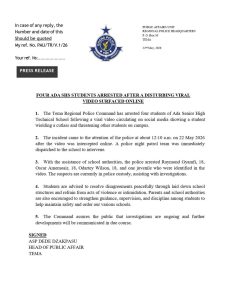
The Tema Regional Police Command has arrested four students of Ada Senior High Technical School after a disturbing video showing a student brandishing a cutlass and allegedly threatening colleagues on campus surfaced online.
According to a police press release issued by the Regional Public Affairs Unit, the incident came to the attention of the police in the early hours of Thursday, May 22, 2026, after officers intercepted the viral video circulating on social media platforms.
The statement indicated that at approximately 12:10 a.m., a police night patrol team was immediately dispatched to the school to assess the situation and restore calm.
With support from school authorities, police arrested four students identified in the footage.
The suspects have been named as 18-year-old Raymond Gyamfi, 18-year-old Oscar Amemoair, 18-year-old Odartey Wilson, and one juvenile whose identity has been withheld due to age considerations.
Police say all four suspects are currently in custody and assisting investigators as efforts continue to establish the full circumstances surrounding the incident.
The Tema Regional Police Command expressed concern over the violent nature of the act captured in the video and cautioned students against resorting to intimidation, threats, or violence in resolving disputes within educational institutions.
The Command urged students to make use of established school disciplinary systems and conflict resolution channels whenever disagreements arise instead of engaging in dangerous behaviour that could put lives at risk.
Parents and school authorities were also encouraged to intensify supervision, counselling, and disciplinary measures to help promote safety, discipline, and peaceful coexistence among students.
“The Command assures the public that investigations are ongoing and further developments will be communicated in due course,” the statement added.
The viral video has since generated widespread reactions on social media, with many Ghanaians expressing concern about growing indiscipline and violent behaviour in some second-cycle institutions across the country.
By 1960nescom

