
The Ghana Gold Board (GoldBod) has signed a GH¢8.4 million funding and implementation agreement with Ghana Water Limited (GWL) to rehabilitate three major water supply systems serving communities in the Western and Central regions.
The intervention will focus on the rehabilitation of the Bonsa, Daboase and Sekyere Heman water supply systems, which have suffered years of operational challenges due to severe pollution, sedimentation and the degradation of nearby water bodies.
The agreement was signed in Accra on Tuesday July 14, with GoldBod describing the initiative as part of its commitment to responsible mining, environmental sustainability and improving access to safe drinking water for Ghanaians.
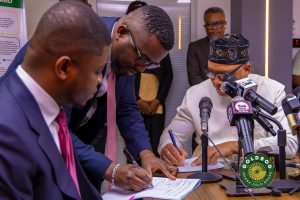
Sammy Gyamfi, Esq., CEO of GoldBod and Adam Mutawakilu, MD of GWL signing the agreement
Speaking at the signing ceremony, Chief Executive Officer (CEO) of GoldBod, Sammy Gyamfi, Esq., disclosed that the Board did not approve the funding solely based on a request from GWL but commissioned a joint technical assessment to establish the extent of the problem.
According to him, the assessment confirmed extremely high turbidity levels in rivers and streams feeding the affected treatment plants, making raw water unsuitable for treatment without urgent intervention.
He explained that engineers also identified severe sedimentation, unstable river channels, and frequent blockages at water intake points, all of which have significantly affected water production in the three facilities.
Mr. Gyamfi noted that although six major water supply systems were identified as requiring urgent rehabilitation, GoldBod had adopted a phased approach because of budgetary constraints.
“As a first phase, we are supporting the rehabilitation of three water supply systems located in mining communities, with the hope of extending support to the remaining facilities in the future,” he said.
The GoldBod CEO stressed that the deterioration of the affected water systems predates the establishment of GoldBod and has accumulated over many years due to illegal mining, sand winning and other activities that have degraded the rivers.
He, however, insisted that assigning blame was less important than finding practical solutions.
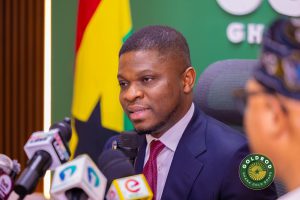
Sammy Gyamfi, Esq., CEO of GoldBod addressing the media during the signing ceremony
“This is about Ghana. It is not about when the problem started; it is about how we solve it,” he stated.
Mr. Gyamfi emphasised that access to clean drinking water is a basic necessity, urging both public and private institutions to support GWL in addressing the country’s growing water challenges.
“Government alone cannot do it. Water is life, and everyone who has the capacity to help must partner Ghana Water Limited to protect this critical national resource,” he added.
Mr. Gyamfi explained that the agreement goes beyond providing financial support and includes clear implementation and accountability measures to ensure value for money.
The rehabilitation works will include desilting of critical water intake systems, dredging operations, hydrographic surveys, sediment volume assessments, reservoir capacity assessments, emergency restoration works, stabilisation of intake infrastructure, safe disposal of dredged materials, water quality monitoring, engineering inspections and post-intervention technical verification.
He said GoldBod would closely monitor the implementation process to ensure the project is executed according to agreed technical standards.
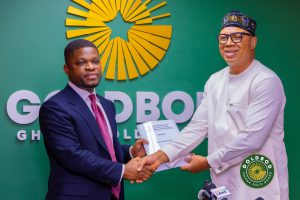
Sammy Gyamfi, Esq., CEO of GoldBod and Adam Mutawakilu, MD of GWL exchanging copies of the agreement
Managing Director of Ghana Water Limited, Adam Mutawakilu, expressed appreciation to GoldBod for what he described as a timely intervention to restore reliable water supply to thousands of residents.
He revealed that Ghana Water has battled increasing turbidity in the affected water bodies since around 2017 and 2018, making water treatment increasingly difficult.
According to him, the challenge had reached a stage where Ghana Water could no longer address it alone, prompting the company to seek support from other state institutions.
Mr. Mutawakilu commended GoldBod for conducting a thorough joint technical assessment before approving the project instead of simply responding to the request with funding.
“It wasn’t just a letter that was sent to GoldBod for approval. A joint technical team visited all the sites and confirmed the need for intervention before this support was granted,” he said.
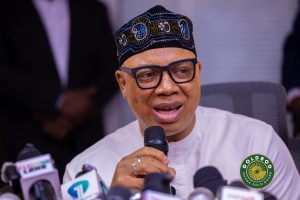
Adam Mutawakilu, MD of GWL
The GWL Managing Director assured GoldBod that the funds would be managed transparently and accounted for fully.
He pledged that every component outlined in the implementation agreement would be executed professionally to pave the way for the second phase of the rehabilitation programme.
Mr. Mutawakilu announced that he would personally lead a team to the Western and Central regions to engage staff and residents ahead of the commencement of emergency dredging works.
He expressed confidence that residents of Bonsa and Daboase in the Western Region, as well as Sekyere Heman in the Central Region, would greatly benefit from the rehabilitation project.
“My board has been fully briefed, and we are deeply grateful for this support. We assure GoldBod that there will be transparency, accountability and proper implementation of every aspect of the agreement,” he said.
The GH¢8.4 million intervention is expected to significantly improve water production at the three treatment plants, restore reliable potable water supply to affected communities and strengthen efforts to protect Ghana’s water resources from the effects of environmental degradation and unsustainable mining activities.
By 1960news.com

