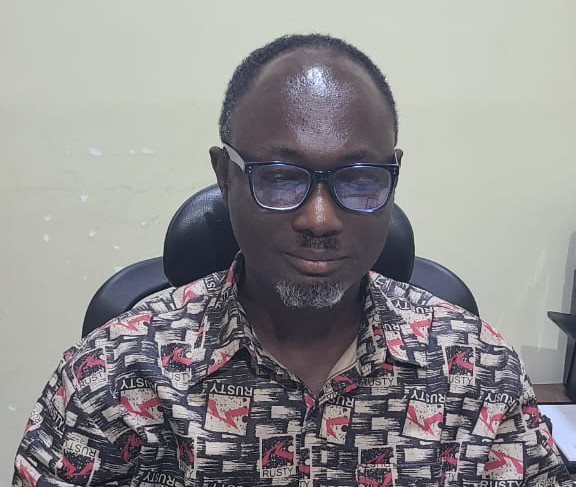
Professor of Physics at the Kwame Nkrumah University of Science and Technology (KNUST), Eric K. K. Abavare, has opposed the Constitutional Review Committee’s (CRC) proposal to extend Ghana’s presidential term from four to five years.
Prof. Abavare argues that the current four-year cycle remains an important accountability mechanism and that extending it would not address the institutional challenges affecting the implementation of government programmes.
In the second part of his nine-part commentary on the CRC proposals, titled “The Presidency: Reject the Five-Year Term; Keep the Rest,” he said he supports most of the Committee’s recommendations on the Executive but disagrees with the proposed extension of the presidential tenure.
Prof. Abavare said the argument that presidents need more time to establish their administrations and implement policies should lead to reforms in Ghana’s transition and public-service systems rather than an extension of the presidential term.
“Four years is not broken, and we should not fix what is working,” he said.
He cited the United States, Brazil, Argentina, Colombia, Costa Rica, Kenya and Liberia as countries that operate four-year presidential cycles, arguing that Ghana does not require a longer tenure simply because administrative processes may be slow.
“If a four-year term can carry Washington, Nairobi, and Brasilia, it can carry Accra,” he stated.
He further contended that there is no credible evidence that longer presidential terms automatically produce better development outcomes.
According to him, a five-year term could instead give governments more time to make mistakes before voters have the opportunity to respond at the ballot box.
With the two-term limit retained, he noted, extending each term to five years would allow a President to remain in office for up to 10 years, compared with the current maximum of eight.
Prof. Abavare proposed four measures to address concerns over the time required for governments to settle in and deliver their programmes.
These include a permanent, non-partisan Office of the Transition to ensure smoother transfers of power; greater continuity in the civil service to protect senior technical officials from wholesale political turnover; a binding National Development Plan to promote policy continuity; and stronger fiscal rules to curb election-year spending and improve financial discipline.
“Build the institutions that make four years sufficient. Do not rewrite the Constitution to accommodate their absence,” he said.
Despite his opposition to the five-year term, Prof. Abavare endorsed several other CRC proposals relating to the Presidency.
He supported retaining and strengthening the two-term presidential limit, arguing that any attempt to introduce a third term or reset the tenure of a sitting President should face the strongest constitutional safeguards.
He also backed reducing the minimum age for presidential candidates from 40 to 30, saying the change would create greater opportunities for younger Ghanaians to seek the presidency while leaving voters free to determine whether they are suitable for office.
Prof. Abavare further supported a hard cap of 57 Ministers, describing it as a measure that could reduce the cost of maintaining a large Executive.
He also endorsed the proposal to prevent sitting Members of Parliament from serving as Ministers, arguing that separating the Legislature from the Executive would strengthen parliamentary scrutiny and reinforce the principle of separation of powers.
While acknowledging concerns about appointing Ministers from outside Parliament, he proposed stronger parliamentary vetting, public hearings and effective mechanisms for Parliament to censure Ministers who fail to perform.
Prof. Abavare welcomed the proposal to remove the constitutional tax exemption on the President’s salary and allowances.
He argued that the President should be subject to the same tax obligations as other workers.
“If a nurse in Korle-Bu pays PAYE on her salary, so should the person who signs her payslip into law,” he said.
He also backed reforms to the appointment of heads of key independent constitutional bodies.
Under the proposed system, the President would retain the formal appointment authority but would be required to act on nominations emerging from a merit-based process involving the reformed Council of State, the Public Services Commission and parliamentary approval.
The proposal covers positions including the Chief Justice, Electoral Commissioner, Auditor-General and heads of institutions such as the Commission on Human Rights and Administrative Justice (CHRAJ) and the National Commission for Civic Education (NCCE).
Prof. Abavare also supported the proposed hybrid appointment process for the Inspector-General of Police (IGP) and Chief of Defence Staff (CDS), under which the President would select from a shortlist of at least three nominees submitted by the relevant Police or Armed Forces Council.
He said the reforms could reduce unilateral presidential discretion and strengthen institutional independence.
Prof. Abavare maintained that the proposed five-year presidential term should be rejected even as other reforms aimed at reducing executive dominance are considered.
“The four-year term is one of the strongest accountability instruments the 1992 Constitution gave the Ghanaian people,” he said.
He urged the public to retain the existing four-year cycle while supporting reforms that promote institutional independence, fiscal discipline, parliamentary oversight and a leaner Executive.
“Reject the extension. Defend the four-year term. Support the rest of the chapter,” he stated.
Prof. Eric K. K. Abavare is an independent national commentator and Professor of Physics in the Department of Physics at KNUST. The views expressed are his personal views.
By 1960news.com