
The Chief of Akwane Dobro in the Nsawam-Adoagyiri Municipality, Nana EKu Yaw II, has called on the government, the National Road Safety Authority (NRSA), and the Driver and Vehicle Licensing Authority (DVLA) to introduce mandatory training and stricter regulations for commercial motorcycle (Okada) riders to help reduce the growing number of road crashes involving motorcycles.
According to the chief, the increasing rate of accidents, injuries and fatalities linked to the unregulated operation of commercial motorcycles has become a major public safety concern that requires urgent intervention.
Speaking to the media during the coronation of 17 sub-chiefs in the traditional area, Nana EKu Yaw II said his appeal aligns with ongoing national efforts to reform and regulate the commercial motorcycle transport sector.
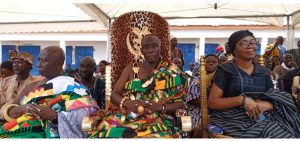
Nana Eku Yaw, Chief of Akwane Dobro, seated in state at the centre alongside other traditional chiefs.
He expressed concern over what he described as the alarming number of accidents involving Okada riders, noting that many young people in the community have suffered life-changing injuries, including amputations, as a result of reckless riding.
The chief also raised concerns about the alleged use of motorcycles in criminal activities such as snatch-and-run robberies and mobile money thefts, explaining that the speed and manoeuvrability of motorcycles often enable suspects to evade arrest.
He further criticised the dangerous riding habits of some operators, accusing them of weaving through traffic, riding against the flow of vehicles, ignoring traffic lights, making illegal U-turns and attempting to outrun police officers.
Nana EKu Yaw II urged the Ghana Police Service to intensify enforcement of road traffic regulations and closely monitor the activities of commercial motorcycle riders.
While acknowledging that the Okada business provides employment and transport services, he argued that the absence of effective regulation has created more challenges than benefits in some communities.
“The introduction of Okada has created a sense of impunity in society. It has worsened the abuse of illicit drugs among some of the youth because the business appears to go hand in hand with drug abuse in certain instances. It has also increased road accidents, with many young people losing their legs or hands despite our continuous efforts as traditional leaders to educate them on safe riding,” he said.
The chief further expressed concern over the conduct of some riders during funeral processions for deceased colleagues, particularly on Fridays when they escort bodies from mortuaries.
He alleged that such processions are often characterised by reckless riding, resulting in additional accidents and casualties.
“I appeal to the police to pay special attention to how these riders operate during such occasions because before long, more people end up dead or seriously injured due to reckless riding,” he added.
Also speaking at the event, the Ahwerease Mankrado Hemaa, Owoahene Sekyibea Dede Mpoa III, expressed similar concerns over the increasing number of motorcycle-related accidents in the area.

Owoahene Sekyibea Dede Mpoa III, Ahwerease Mankrado Hemaa
She appealed to the relevant authorities to take swift action to improve safety and protect lives.
The queen mother also advised young people to stay away from illicit drugs and lifestyles that expose them to teenage pregnancy and other social vices.
Instead, she encouraged them to remain committed to their education and personal development to secure a brighter future.
The coronation ceremony, which saw the installation of 17 sub-chiefs, attracted traditional rulers, political figures, community leaders and residents who gathered to witness the colourful event.
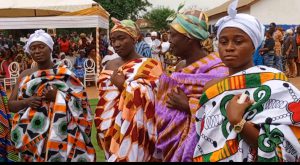
The ceremony also highlighted the growing involvement of young people and women in traditional leadership, with the majority of the newly installed sub-chiefs being youth, while seven of the 17 chiefs installed were women.
By 1960news.com

