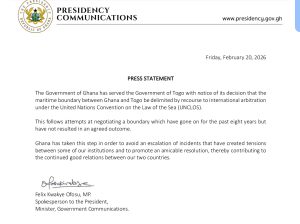
The Government of Ghana has officially notified the Republic of Togo of its decision to seek international arbitration to resolve a long-standing maritime boundary dispute.
The move, announced today Friday February 20, by the minister for government communications and spokesperson to the President, Felix Kwakye Ofosu, invokes the dispute resolution mechanisms under the United Nations Convention on the Law of the Sea (UNCLOS).
The decision to transition to arbitration follows nearly a decade of diplomatic efforts.
According to the official statement, both nations have engaged in extensive negotiations for the past eight years.
However, these bilateral talks have failed to produce a mutually agreed-upon boundary.
By moving to international arbitration, Ghana aims to reach a definitive and legally binding conclusion that the negotiation table could not provide.
The primary motivation behind this legal step is the preservation of regional stability.
In recent years, the undefined boundary has led to friction between state institutions of both countries.
”Ghana has taken this step in order to avoid an escalation of incidents that have created tensions,” the statement noted.
The government emphasized that the goal is to:
Promote an amicable resolution to the territorial overlap.
Prevent operational clashes between maritime and security agencies.
Uphold the “continued good relations” currently shared between the two West African neighbors.
The Role of UNCLOS
Under UNCLOS, countries that cannot reach a maritime agreement through negotiation can seek third-party intervention.
This typically involves an international tribunal or an arbitral board that evaluates historical claims, geographical data, and international law to draw a fair boundary line.
The Government of Ghana remains optimistic that this structured legal process will provide the clarity needed to foster economic cooperation and maritime security in the Gulf of Guinea.
Below is the full statement