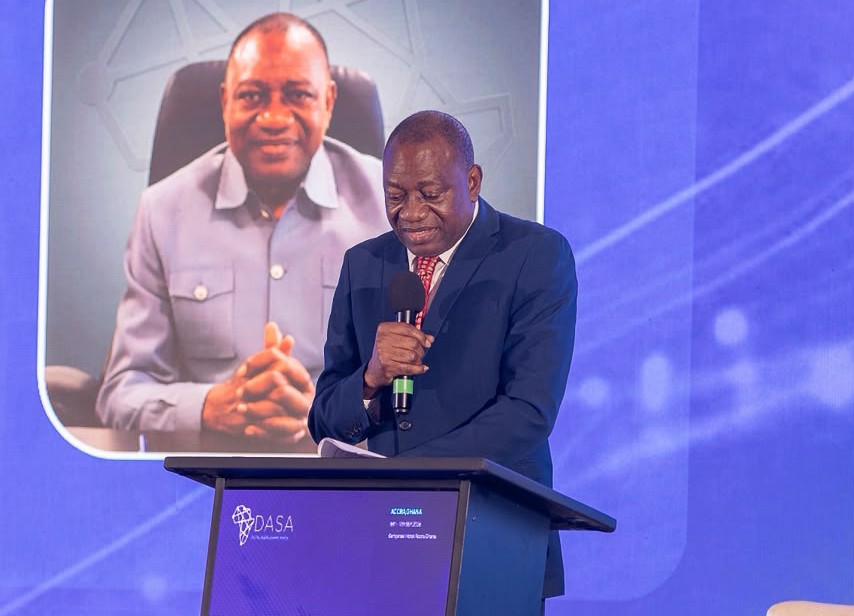
Minister of State in charge of Special Initiatives, Dr. Abdul-Rashid Hassan Pelpuo, has made his maiden public appearance in his new role, delivering the keynote address at the Digital Assets Summit Africa (DASA) 2026.
The summit brought together stakeholders from across the digital economy, technology, finance and investment sectors to examine how Africa can leverage digital assets and emerging technologies to accelerate economic transformation.
Held under the theme, “From Policy to Prosperity: Scaling Digital Assets for Investment, Jobs and Economic Growth in Africa,” the summit focused on the opportunities and challenges associated with the rapid expansion of digital assets across the continent.
In his address, Dr. Pelpuo expressed appreciation to the organisers for providing a platform for policymakers, industry players and other stakeholders to deliberate on the future of Africa’s digital economy.
He said Ghana’s ongoing digital transformation was opening up significant opportunities in investment, financial services, innovation and employment, particularly for young people.
However, the Minister stressed that the availability of opportunities alone would not be enough to guarantee meaningful economic benefits.
According to him, the critical task for policymakers is to create an environment in which innovation can thrive while ensuring that digital activities are properly regulated, secure and capable of delivering tangible benefits to citizens.
Dr. Pelpuo pointed to Ghana’s strengthened regulatory framework for virtual assets under the Virtual Asset Service Providers Act, 2025 (Act 1154) as an important step towards creating a structured and responsible digital-assets ecosystem.
The legislation provides for the registration, licensing and supervision of virtual asset service providers, with emphasis on consumer protection, cybersecurity and responsible innovation.
He said effective regulation was necessary to build confidence among investors, businesses and consumers while creating room for legitimate innovation within the digital economy.
The Minister also underscored the need for Ghana and other African countries to ensure that the development of digital assets translates into opportunities beyond financial transactions.
Dr. Pelpuo highlighted the growing demand for skills in areas including software development, cybersecurity, financial technology, data analysis, regulatory compliance and digital marketing.
He said the expansion of these fields presented an opportunity for Africa’s youthful population to become active participants in the digital economy rather than remaining largely consumers of technologies developed elsewhere.
The Minister cited government programmes including the One Million Coders Programme, National Artificial Intelligence Strategy, YouStart, and the Smart City and Digital Infrastructure Programme as part of efforts to equip young people with skills required for the changing labour market.
He said such interventions were intended to position young people to take advantage of emerging opportunities created by digitalisation and technological advancement.
Dr. Pelpuo further disclosed that, under the leadership of President John Dramani Mahama, he had secured $50 million towards the establishment of a new Skills University.
He also disclosed an additional $82 million to equip young people with the skills needed to participate in the digital transformation of the labour force.
According to him, the investments demonstrate the government’s intention to move beyond policy pronouncements and create practical pathways for young people to acquire relevant skills and participate in the emerging economy.
He said the focus must be on creating opportunities for employment, entrepreneurship and innovation while supporting broader economic growth.
Dr. Pelpuo challenged Ghana and other African countries to change their approach to technology by moving beyond the role of consumers to becoming creators, developers and owners of digital solutions.
He argued that Africa possesses unique challenges that require locally developed technological solutions capable of responding to the continent’s specific economic and social realities.
Among the areas he identified were agriculture, trade, financial inclusion, remittances and financing for small businesses.
He said developing home-grown digital solutions in these areas could help African countries address longstanding economic challenges while creating new businesses and employment opportunities.
The Minister stressed that Africa’s digital transformation should ultimately be judged by its impact on ordinary citizens.
He said success should not be measured solely by the number of digital platforms, technologies or policies introduced, but by whether those interventions create jobs, attract investment, promote entrepreneurship, strengthen institutions and improve the quality of life.
Dr. Pelpuo’s maiden appearance in his new ministerial role therefore placed strong emphasis on linking technology and digital assets to practical economic outcomes.
His participation at DASA 2026 also provided an opportunity for government to engage directly with stakeholders in the rapidly evolving digital-assets ecosystem as Ghana seeks to position itself for greater participation in the global digital economy.
By 1960news.com