
The University of Cape Coast (UCC), through its College of Agriculture and Natural Sciences, has established the Africa Centre for Food Integrity (AFIC), an initiative aimed at tackling food fraud, adulteration and counterfeiting through affordable, science-driven and artificial intelligence (AI)-enabled technologies.
A major innovation being developed by the Centre is the ‘Food Oracle’, a technology designed to assess food authenticity, quality and safety in less than a minute without destroying the samples being tested.
The Centre was officially launched under the theme, “Advancing Food Integrity through Science, Innovation, Capacity Building and Partnerships.”
According to the School of Agriculture, AFIC will focus on developing portable testing technologies that can be deployed closer to farms, markets, food processing facilities and inspection points to determine the authenticity, quality, safety and origin of food products.
As part of the initiative, a fully equipped laboratory with specialised scientific equipment has also been established at the University to support research, testing and innovation.
The facility will be accessible to students, researchers, individuals, organisations and other tertiary institutions interested in conducting studies and advancing food integrity research.
Speakingt with the media, Founding Director of AFIC, Engr. Prof. Ernest Teye, explained that the Centre was developing the Food Oracle using technologies designed to replicate the five human senses in examining food products.
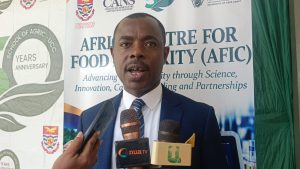
Prof. Ernest Teye, Director, ACFI UCC
He said the system combines an electronic nose, electronic tongue, acoustic sound analysis, computer vision and near-infrared spectroscopy to detect characteristics that could indicate food adulteration or compromised quality.
According to him, integrating these technologies with artificial intelligence will enable the Centre to produce rapid results without damaging the food samples.
“The Food Oracle is actually using all your five senses. Your nose, so we have electronic nose; your tongue, we have electronic tongue; the ear, we have acoustic sound; the eye, we have computer vision; and now we have near-infrared spectroscopy, which we equate to touch.
“When you add all this, we are developing what we call AI technologies that give results non-destructively. In less than one minute, you get your results,” he explained.
Prof. Teye said the Centre was conducting research into technologies capable of assessing different aspects of the food supply chain, with plans to make its innovations available to the Food and Drugs Authority (FDA) and other stakeholders in the food industry.
He further disclosed that AFIC was preparing to introduce a product known as ‘Spice Check Technology’, which will enable consumers to determine the authenticity of spices sold in markets.
Another innovation in the pipeline is a portable palm oil testing device designed to identify possible adulteration in palm oil products.
He explained that the devices would initially serve as screening tools, providing immediate results to help identify suspicious food samples. Products that raise concerns could subsequently be referred to advanced laboratories for more comprehensive scientific examination.
Beyond technological development, Prof. Teye said AFIC would prioritise public education, affordable testing solutions and human resource development to strengthen the fight against food fraud, adulteration and counterfeiting.
He described the practices as a growing threat to the integrity of food systems and stressed the need for coordinated interventions to protect consumers.
The Dean of the School of Agriculture at UCC, Prof. Julius Kofi Hagan, described the establishment of AFIC as a significant achievement for the institution, particularly as the School celebrates its 50th anniversary.
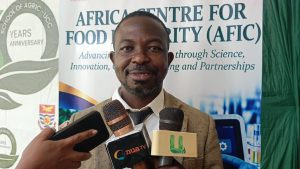
Prof Julius Kofi Hagan, Head Dept,Sch of Agric UCC
He observed that food fraud, adulteration and contamination continued to pose serious challenges to public health and commercial activities in Ghana and other parts of Africa.
Prof. Hagan said the Centre’s establishment was timely, as it would provide scientific and technological interventions to help ensure that food products available on the Ghanaian market meet acceptable standards of safety, authenticity and nutritional quality.
He explained that AFIC’s responsibilities would extend beyond laboratory research to include training, capacity building and collaboration with relevant regulatory institutions, including the FDA and the Ghana Standards Authority (GSA).
The Dean expressed confidence that such partnerships would help translate research findings and technological innovations into practical solutions for the food industry.
He also commended the Founding Director, Engr. Prof. Ernest Teye, and his team for spearheading the initiative, assuring them of the School’s commitment to supporting the Centre’s growth into a leading hub for food integrity research across the continent.
“Food fraud and adulteration are major challenges. AFIC will provide the science, innovation and training needed to ensure food integrity in Ghana and Africa. We, as a School, are fully behind this initiative,” he stated.
The Ambassador of the State of Israel to Ghana, Liberia and Sierra Leone, H.E. Roey Gilad, has also welcomed the establishment of AFIC, describing it as an initiative with the potential to deliver practical benefits to Ghanaian farmers and the wider agricultural sector.
Mr Gilad, who disclosed his family’s background in farming, including avocado cultivation, said Israel was pleased to be associated with the project and remained committed to supporting UCC and Ghana in strengthening food quality, safety and integrity.
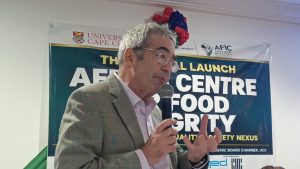 H.E. Roey Gilad, Israel Ambassador
He noted that agricultural technology and food systems were important areas of cooperation between Israel and Ghana, adding that his country, which has developed considerable expertise in agricultural innovation, was keen to support initiatives that connect scientific research with farming practices.
The Ambassador expressed optimism that AFIC would serve as an important link between researchers, technology developers and farmers, ensuring that scientific innovations translate into tangible improvements within the agricultural value chain.
The launch of the Africa Centre for Food Integrity brought together university authorities, researchers, students and development partners, highlighting the importance of collaboration in addressing challenges confronting Ghana’s food industry.
With its focus on artificial intelligence, scientific research, affordable testing technologies and capacity development, AFIC is expected to contribute to efforts to improve food monitoring and strengthen consumer confidence in products sold on the market.
The Centre’s planned collaboration with regulatory institutions and stakeholders across the food value chain is also expected to support the detection of fraudulent products and promote higher standards of food safety and authenticity in Ghana and beyond.
Story by Kwame Kakraba

